
Small Gift and Travel Runs Are Rewriting the OEM and ODM Divide
The old split was simple: OEM meant you bring a formula and a specification, ODM meant you take a scent and a pack off the shelf. Small gift and travel runs have blurred that line, because the volume is too small to justify full customisation and too visible to accept a generic result. What changed is not the definitions but the expectations placed on both models, and buyers now have to verify more than the label on the contract.
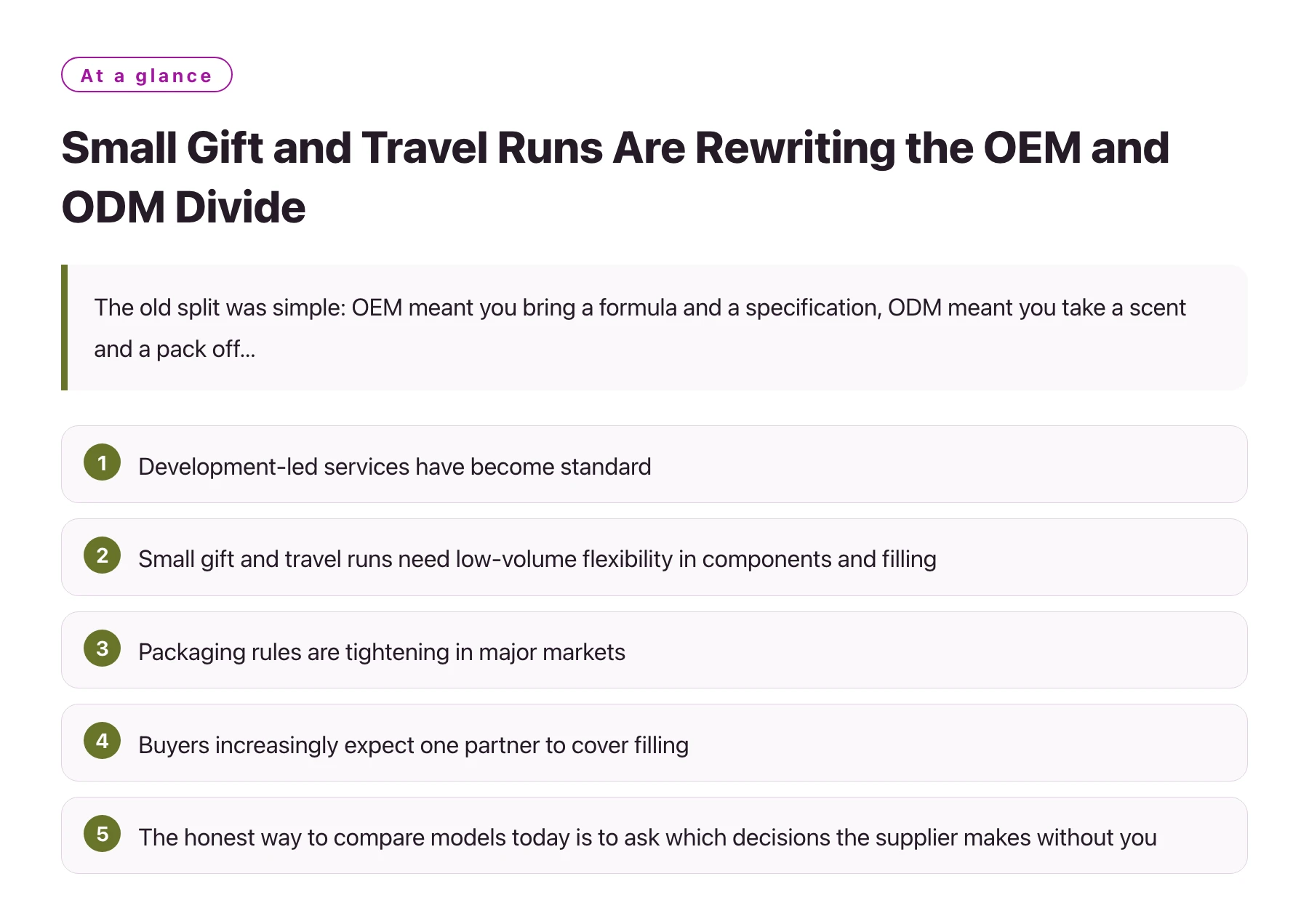
Key takeawaysDevelopment-led services have become standard, so the practical difference between OEM and ODM is often who owns the brief rather than who can create a scent. · Small gift and travel runs need low-volume flexibility in components and filling, which is where the two models now differ most. · Packaging rules are tightening in major markets, and that pressure reaches small formats first because they use more material per millilitre sold. · Buyers increasingly expect one partner to cover filling, decoration and set assembly, which stretches the classic OEM definition. · The honest way to compare models today is to ask which decisions the supplier makes without you, not which label it uses.
Buyers who learned the OEM and ODM distinction a decade ago often arrive at a first meeting with a mental model that no longer matches the market. They expect ODM to mean generic and OEM to mean bespoke, then find that a development-led manufacturer will create a scent under either label.
The formats that changed fastest are the small ones. Discovery sets, travel sprays and gift presentations are now a normal part of a launch plan rather than a seasonal add-on, and they put pressure on exactly the parts of a manufacturing relationship that used to be negotiable.
What actually changed, and what did not
What did not change is the core of the two models. In OEM the brand owns the specification and the manufacturer reproduces it. In ODM the manufacturer supplies a developed product that the brand adapts. Those definitions still describe how responsibility is allocated.
What changed is the layer on top. Manufacturers now package development, design and compliance support around both models, so a buyer can commission a bespoke scent without owning a formula library, and can buy an ODM platform with a level of packaging customisation that would once have been considered OEM work.
Market research coverage of launch activity shows how quickly new fragrance products and formats appear [1]. That pace is one reason small formats matter commercially: a travel spray or a discovery set lets a brand test a scent and a price point without committing to a full presentation.
The practical consequence is that the model label tells you less than it used to. When you compare partners, the question that separates them is who makes decisions without consulting you. A manufacturer that will select a component, propose a fill weight and manage a decoration supplier is offering a different working relationship from one that waits for a drawing, and that difference is exactly what separates a supplier describing fragrance manufacturing under one roof from one that expects you to coordinate every step yourself.
Development became a service, not a phase
Once development is offered as a service, the boundary between the models moves to the brief. In an OEM project the brand typically owns the brief and the formula; in a development-led ODM project the manufacturer may write the brief from a short written direction and then own the platform the result sits on.
That shift is convenient and it carries a question: what happens to the work if you leave? Ask whether the scent can be transferred, what documentation moves with it, and whether the platform can be used by another brand at the same time.
Small runs changed the economics of components
A small travel format does not need much liquid, but it still needs a container, a closure, a label and a pack. For a run of a few thousand units, component availability often decides the schedule more than the fragrance does, and a supplier with a wide component catalogue can start sooner than one that must commission tooling.
This is the part of the market where ODM-style offers have gained most, because a platform component already exists in the right size and shape. The trade-off is repetition: if the same component appears across many brands, decoration and naming have to do the differentiating work.
Then and now, in the parts buyers actually negotiate
| Area | Earlier practice | What buyers see now | What to verify |
|---|---|---|---|
| Scent development | ODM meant choosing from a finished list | Development is offered inside both models | Who owns the result and whether it can be transferred |
| Packaging | Bespoke tooling assumed for a custom look | Platform components with custom decoration | Component exclusivity and repeat-order availability |
| Run size | Minimums set by the bottle or the batch | More flexibility claimed on small formats | Which minimum applies, per component, in writing |
| Material choice | Cost and appearance led the decision | Recyclability and packaging waste rules matter | Whether the compliance route covers the finished pack [2] |
| Scope | Filling and packing were separate contracts | One partner for fill, decorate and assemble | Where the supplier's own quality chain hands off |
The table is not a list of improvements. Three of the five rows describe a transfer of work from the buyer to the supplier, which is convenient when the supplier is competent and expensive when it is not. Verify each row before the first purchase order, not after the first repeat order.
Where the two models now overlap
In practice, many small gift and travel projects sit in the overlap. The brand owns the brand, the naming and the commercial plan; the manufacturer decides the fill weight, the component pairing, the decoration route and the assembly sequence. Neither party would describe that split as pure OEM or pure ODM.
The overlap is workable as long as both sides agree where it stops. Write down the decisions the supplier may make without approval, the decisions that need written sign-off, and the decisions that remain yours. Projects rarely fail because a supplier overstepped; they fail because nobody defined the line in advance.
Documentation is what makes the overlap safe. A scent that can be reproduced and a pack that can be reordered depend on records, and trade coverage of contract manufacturing increasingly treats documentation and traceability as a selling point rather than as an administrative task [3].
Buyers who want to see how a single partner describes development, filling and packing in one scope can compare how the pages behind full ODM fragrance service are presented, and then test the description against the questions above. A partner that markets a single-contract scope should be able to explain, without hesitation, which of those decisions it makes alone.
What this means for a first order
For a first run, the overlap is usually an advantage. It shortens the schedule and removes the need to coordinate several suppliers before you have even sold a unit. The risk is that a first order is too small to reveal whether the supplier's internal handoffs work, so the reference sample and the inspection points matter more than usual.
It also means your own documentation must be complete from day one. If you do not hold a signed reference standard, an approved artwork file and a component list, a repeat order becomes a renegotiation rather than a reorder.
What to watch as the line grows
The overlap that helped at 3,000 units can become a constraint at 30,000. A supplier that managed your project through existing platform components may not be able to guarantee exclusivity on them at higher volume, and the cost advantage of shared components can disappear once you want a pack nobody else uses.
Plan the transition before you need it. Decide the volume at which you would commission a bespoke component, and ask early what tooling, timing and ownership that would involve. Suppliers answer that question differently depending on how much of their business comes from small runs.
Where to start if you are comparing now
Start with the company's own account of what it does and who it does it for. the Xuelei website sets out a manufacturing scope and a set of locations, and reading it alongside a supplier's answers is a quick way to see whether the marketing description and the operational description match.
The point is not to find a supplier whose model label matches your expectations, since the labels no longer describe the work precisely. The point is to find one whose answers stay consistent when you ask the same question in three different ways.
The most useful question in a modern OEM or ODM conversation is not which model the supplier offers. It is: if this project goes well and we triple the volume, what changes and what does not? A supplier that has thought about that answer is usually the one that has run small gift and travel projects before.
Sources
- Mintel Press Centre —— Mintel's press releases on consumer and beauty market research, including fragrance and personal care trend reporting.
- European Commission: Packaging Waste and the PPWR —— EU rules on packaging and packaging waste, including the Packaging and Packaging Waste Regulation requirements on recyclability and design.
- Cosmetics Business —— A trade publication covering the beauty and cosmetics industry, including fragrance launches and regulatory developments.
Frequently asked questions
Has ODM replaced OEM for small fragrance runs?
No. ODM has become more flexible and development-led, but OEM still suits brands that own a formula or need a specification reproduced exactly. For small gift and travel runs the two models often coexist inside one launch.
Why do packaging rules affect small formats more?
Small formats use proportionally more packaging per millilitre of product sold, so material choices, recyclability and empty space rules have a larger relative effect. Buyers selling into the EU should confirm how the finished pack meets current packaging requirements.
What is the biggest risk in a development-led ODM project?
Ownership drift. If the manufacturer develops the scent and holds the platform, the brand may not hold enough documentation to move the product later. Settle ownership and transfer terms in the contract before development starts.
Can one supplier handle filling, decoration and assembly for a gift set?
Many can, and one-contract scopes have become normal for small formats. The thing to verify is not the offer but the handoffs: who inspects each step, against what standard, and who is accountable if the assembled set does not match the approved sample.
How should a first-time buyer choose between the models?
Choose based on what you are able to manage. If you cannot run fragrance development, sampling and packaging approvals in-house, a development-led model will save months. If you own a formula and a pack specification, an OEM route keeps control and usually reduces cost.